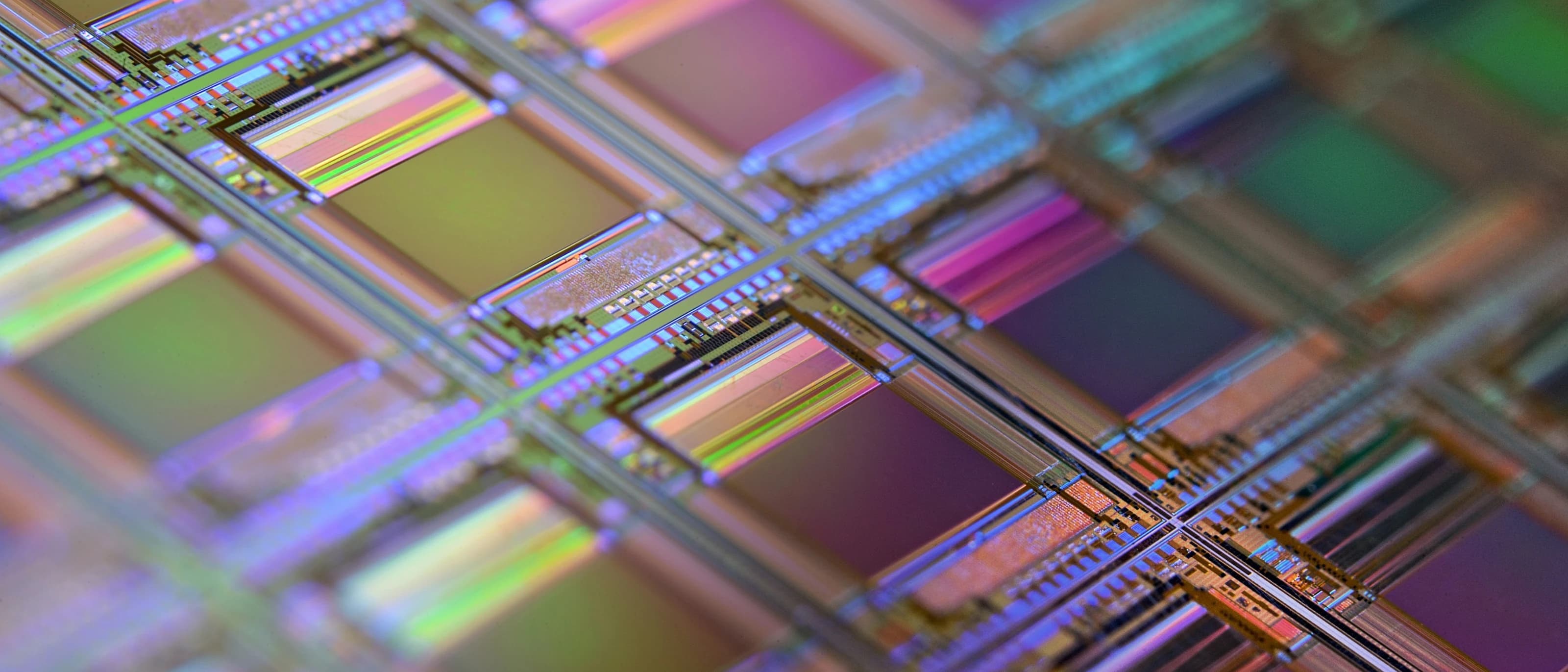
The stack
Four layers, all ours.
One sovereign runtime, built from the silicon up — from the register NavHAL writes to, up to the aircraft VAYU flies.
- 1 kHz
- Real-time control loop
- ~5.9 µs
- Task-wake latency
- 0
- Foreign flight-critical deps
- 4 layers
- Owned, silicon to sky
The principle
Own every layer.
Most flight software is stacked on borrowed frameworks that nobody fully controls. We took the opposite path. From the chip to the sky, every layer is ours — so there are no black boxes, no foreign dependencies, and nothing in the flight path we cannot read, test and trust.
The stack
Four layers, all ours.
The aircraft rests on an operating system, which rests on a hardware layer, which rests on the silicon. Read it top to bottom — VAYU in the air, down to the register.
- L3
VAYUFlight application
The aircraft itself — reading its sensors, estimating attitude, running the control loops, and driving the motors.
- Cascaded PID
- 1 kHz / 250 Hz loops
- Complementary + Mahony
- Fail-safe recovery
- L2
VaiOSReal-time operating system
The core that decides what runs and when, holding the control loop to a fixed schedule every cycle. This is the layer built to grow.
- Preemptive kernel
- ~5.9 µs task-wake
- Benchmarked vs FreeRTOS & Zephyr
- L1
NavHALHardware abstraction layer
Speaks straight to the silicon and hides the differences between chips — so the same flight code moves to new hardware untouched.
- ~5-cycle GPIO
- Register-level, zero-cost
- STM32F4 · H7 · AVR
- L0
SiliconThe board it flies on
The physical hardware the whole stack runs on — a reference board today, in-house boards next.
- STM32F401RE
- Cortex-M4F @ 84 MHz
- BMX160 IMU >1.5 kHz
The horizon
Built to grow.
Today the stack flies a drone. The same runtime is designed to coordinate many aircraft, and to reach beyond drones as it matures. UAVs come first because that is where we are proving it — getting the hard real-time core right is what earns the right to carry it further.
Next
The report, the guides, the benchmarks.
All of it is public — including the head-to-head against FreeRTOS and Zephyr on the same hardware.